Sky Words: Brain Puzzle Games
- 4.8
- Rating
- 1.00M
- Installs
- Free
- Price
 Analysis by App-foxy
Sky Words: Relax Puzzle Games is the kind of word game I open when I want something quieter than a competitive match and more engaging than simply scrolling. It comes from Malpa Games, is free to download, and places letter puzzles inside a soft, unhurried presentation. My first impression was that it understands its audience: this is aimed at adults who want to exercise their vocabulary without feeling as if they have started a demanding study session.
The basic appeal is easy to understand. You work with letters, search for words, and move through puzzles at a pace that feels deliberately gentle. That sounds simple, but the success of a game like this depends on how well its visual style, sound, difficulty curve, and interaction design support that promise. In my experience, Sky Words is strongest when I treat it as a short mental reset rather than a game I must conquer in one sitting.
Its store short description is simply “Sky Words,” while the full experience is presented as relaxing word play for adults. That distinction matters because the game’s identity is not built around a complicated story or a large collection of systems. Its character comes from the way it frames familiar word mechanics. The result is approachable, but it also means players looking for deep competition, elaborate progression, or a narrative campaign may find the experience too restrained.
You May Also Like

 Blood Strike: 2.5 Anniversary
Blood Strike’s Loadouts Turn Every Drop Into a Tactical Gamble
A close look at Blood Strike’s custom loadouts: how fast access to signature weapons reshapes its battle royale rhythm, rewards preparation, and narrows the gap between fights.

 Pandora - Music & Podcasts
Pandora’s Music Is Easy to Start, but Harder to Recover
Pandora’s strength is its low-effort path from a seed to a station. Its weak spot is how much confidence it asks you to place in connection, setup, and quiet recovery.

 8 Ball Pool
 Is Built on Rivalries, Rematches, and Routine
A close look at the rivalries, rematches, shared routines, and unanswered safety questions that turn a quick pool match into a persistent mobile community.

 Samsung Music
’s Quiet Strength Is Playing What You Already Own
Its reach comes less from spectacle than from dependable access to a personal library. That simplicity is both the app’s strongest retention engine and its ceiling.

 AccuWeather: Weather Radar
AccuWeather Review: A Quick, Clear Forecast for Everyday Decisions
For everyday plans, the best forecast is the one you can understand quickly. AccuWeather makes rain timing, radar, and local conditions easy to act on, with a few trade-offs.

 Hill Climb Racing
Why Hill Climb Racing Still Turns Crashes Into One More Run
A tiny car, a bumpy hill and one more upgrade: Hill Climb Racing keeps resurfacing because its simple chaos makes every near-miss feel personal.
More From Our News Desk



A calm first impression that sets the right expectations
When I first approached the game, I did not feel pressured to learn a long set of rules. The presentation points toward a short-session experience, and that makes it easy to begin with only a few spare minutes. I can imagine using it while waiting for an appointment, winding down before bed, or taking a break between more demanding tasks. It does not ask me to remember a complicated control scheme before the actual word solving begins.
The free entry point is useful here. I can try the central puzzle experience without making an immediate purchase decision, then decide whether the style suits me. Optional purchases range from $0.99 to $249.99 per item, so I would advise checking the purchase prompts carefully and keeping the game’s optional spending separate from its basic appeal. The fact that a game is free to start does not automatically make every purchase worthwhile, and Sky Words is best judged first by how satisfying its ordinary puzzle loop feels.
There is also a reassuring sense of maturity in the intended tone. The content rating is Teen, and the game is not presented as a noisy children’s spelling exercise. That makes it a better fit for adults who enjoy vocabulary games but want a more composed atmosphere. I would still consider the rating before handing it to a younger player, especially because “word game” alone does not tell you whether the overall presentation matches your household’s preferences.
On Android, it supports operating system version 8.0 and later. That gives it a reasonably broad technical starting point for players using older compatible phones, although the practical experience will still depend on the device’s screen, responsiveness, and battery condition. I found the game most comfortable when I could give the puzzle my full attention for a few minutes rather than trying to play while doing something else.
The visual language makes ordinary puzzles feel like a retreat
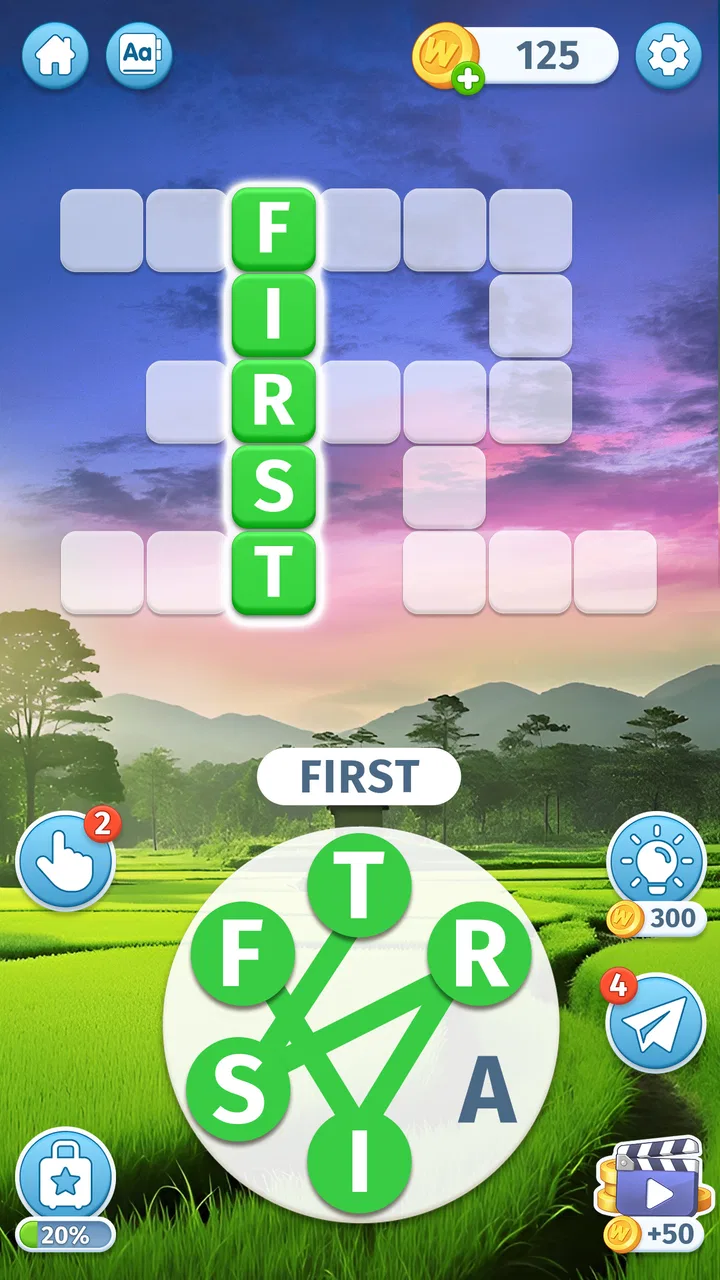
The art direction is important because the underlying activity is familiar. Letter puzzles can easily look like a grid of tasks, but Sky Words works better when the surrounding presentation encourages me to slow down. Its mood suggests open space and calm rather than urgency. That gives each puzzle a little breathing room and makes the game feel more like a small destination than a checklist of vocabulary tests.
I especially appreciate how this visual approach changes my attitude toward mistakes. In a highly competitive word game, an incorrect attempt can feel like a failure that interrupts momentum. Here, the gentler setting makes experimentation feel more acceptable. I am more willing to try an unusual combination, pause, and look at the available letters again instead of rushing toward the first obvious answer.
That is one of the game’s less obvious strengths: the scenery and interface can influence how patiently I solve. The visual style does not replace good puzzle design, but it supports a particular kind of attention. I am not playing to produce a dramatic score or defeat another person. I am playing to notice patterns, test vocabulary, and enjoy the small satisfaction of finding a word that was hiding in plain sight.
There is a trade-off, though. A calm presentation can make the experience feel less energetic than alternatives built around streaks, timers, or daily competition. If your enjoyment comes from pressure, leaderboards, rapid rounds, or the excitement of beating a personal record, Sky Words may seem too soft. Its art direction is coherent with its purpose, but that purpose is relaxation first and intensity second.
I also would not choose it as my main tool for disciplined language learning. Solving word puzzles can sharpen recognition and recall, but it is not the same as following lessons, studying definitions, or practicing conversation. The game works best as an enjoyable vocabulary activity, not as a replacement for a structured language course or a serious dictionary workflow.
Sound and pacing keep the mood from becoming stressful
Sound is easy to overlook in a word game, yet it can determine whether a quiet design feels pleasant or merely empty. Sky Words benefits from treating audio as part of the atmosphere rather than using it to create constant excitement. The overall impression is suited to focused play: I can concentrate on letters without feeling that every move needs a dramatic reaction.
The pacing follows the same principle. The game does not need to turn every puzzle into a race. A slower rhythm gives me time to inspect the available letters, consider less obvious word forms, and decide whether I am solving carefully or simply guessing. That makes it particularly comfortable for evening play, when a fast, brightly competitive alternative might feel like the wrong kind of stimulation.
One practical tip is to treat the sound setting as part of your chosen activity rather than leaving it to chance. If I am playing in a public place, I can keep the phone quiet and still use the visual rhythm of the puzzles. At home, gentle audio can help create a more complete break from work. The important point is that the game’s mood does not depend on constant noise, so it remains usable in situations where a more animated word title would be distracting.
The slower rhythm also changes how I measure progress. I do not judge a session only by how many puzzles I complete. Sometimes the better result is that I spend several minutes concentrating on one small problem and finish feeling refreshed rather than mentally crowded. That is a meaningful distinction from word games designed around daily streak maintenance, where missing a session can become more stressful than enjoyable.
Still, players who need a strong sense of forward momentum may want more visible urgency. Relaxed pacing can blur the difference between a satisfying session and a repetitive one if the puzzle variety does not keep surprising you. I would recommend trying the free experience during both a short break and a longer session. That quickly reveals whether the calm tempo feels restorative or simply too slow for your habits.
Why the mechanics fit the atmosphere
The central mechanics are familiar enough to understand quickly, but that familiarity is part of the design’s advantage. I do not have to spend my first session learning a complex rule set. My attention goes toward letter relationships, word recognition, and the satisfaction of completing a puzzle. The interface and pacing support the act of thinking instead of competing with it.
A useful way to play is to divide each puzzle into passes. First, I look for the most obvious short words and use them to understand the available letter patterns. Then I search for longer or less immediate possibilities. Finally, I revisit the remaining spaces without assuming that the answer must be a word I use every day. This approach reduces random tapping and makes the game feel more like deliberate observation.
Another practical habit is to avoid treating hints or assistance as a first resort. When I pause for a moment, I often notice a letter combination that was visually present but mentally ignored. Saving help for genuine dead ends makes the eventual solution more rewarding. It also preserves the relaxing quality, because I am giving myself time to solve rather than turning every puzzle into a speed test.
This is where Sky Words differs from more aggressive alternatives in the same broad category. Competitive word games often reward fast recognition, repeated streaks, or comparison with other players. Educational word apps may focus on definitions, spelling drills, or organized lessons. Sky Words sits between those approaches: it gives me a reason to think about language, but the main reward is the calm process of solving rather than measurable academic progress or social status.
That middle position is both its appeal and its limitation. I can recommend it to someone who wants a low-pressure mental exercise, especially if conventional puzzles feel too stark or competitive. I would point a serious learner toward a dedicated vocabulary app, and I would send a competitive player toward a title with timed rounds or rankings. Sky Words is not trying to win either of those battles, and it should not be criticized for failing to become something else.
The game’s current version is 1.8.0, which is useful to know when checking compatibility and deciding whether your installed copy is current. I would keep the app updated through the normal store process, particularly with a game whose comfort depends on smooth touch response and reliable puzzle presentation. The minimum operating system is Android 8.0, so users on older software should check their device before planning around it.
There is also a personal-use trade-off around purchases. Because the game is free, I can approach it casually and see whether I return to it naturally. The available in-app items may appeal to players who want to support the developer or add convenience, but I would not let purchase prompts define the value of the basic experience. My own rule would be simple: play enough free content to know whether the solving loop itself is enjoyable before spending anything.
Everyday situations where it works best
The clearest use case is a short decompression break. After finishing a demanding task, I can play one or two puzzles and shift my attention toward something focused but not urgent. Unlike passive scrolling, this gives my mind a small problem to hold. Unlike a competitive game, it does not add another source of pressure when I am already tired.
It can also work well during travel or waiting time, provided I have the phone available and do not need uninterrupted attention for another responsibility. The compact nature of word solving makes it easy to stop between puzzles. I would not begin a session while crossing a busy street, supervising a child, or handling anything that requires immediate awareness, but it is a sensible companion for an ordinary waiting room or quiet commute.
For older adults who enjoy word activities, the relaxed presentation may be more inviting than a flashy game built around rapid effects. That does not mean every player will find the vocabulary level comfortable, and the Teen rating remains relevant, but the broad idea is accessible: look at letters, make connections, and progress without a timer dominating the experience.
It is less suitable for groups. If I want a social activity, I would choose a multiplayer word challenge or a pass-and-play format where conversation is part of the fun. Sky Words feels personal and inward-looking. Its strength is the private pause it creates, not the shared excitement of comparing answers around a table.
I would also skip it if I need a game with a strong narrative setting. The atmosphere provides a coherent emotional backdrop, but it is there to support the puzzles rather than carry a story. Players who want characters, plot twists, exploration, or a sense of a large world unfolding should look elsewhere. Here, the setting is a frame for concentration.
What the audience response suggests, and how I read it
The game has an average rating of 4.8 from around 118 thousand ratings, with roughly 1.1 thousand written reviews. It has also passed one million installs. Those figures suggest that the relaxed word-puzzle formula is connecting with a substantial audience, but I would still interpret them carefully. A high rating tells me that many players enjoy the overall experience; it does not guarantee that its calm tempo will suit someone who prefers speed or competition.
For me, the strongest signal is not popularity by itself but the consistency between the audience appeal and the design direction. The game’s quiet art, measured rhythm, and accessible letter mechanics all point toward the same use case. When a game has that kind of coherence, I am more likely to keep it installed because I know exactly when I want to open it.
The developer, Malpa Games, has positioned the title as a focused word experience rather than an overloaded collection of unrelated activities. That focus is valuable on a phone. I know what I am getting when I launch it, and I do not have to navigate through a maze of systems before reaching the part I came for.
At the same time, focus can expose repetition more clearly. If the puzzle structure does not match your preferred style, there are fewer secondary modes to distract you or provide an alternative route into the game. This is why I would not rely on the rating alone. Spend a little time noticing whether the letter challenges remain satisfying after the initial novelty of the artwork fades.
My atmosphere verdict after looking past the first impression
Sky Words: Relax Puzzle Games succeeds because its visual direction, sound, and pacing all support the same promise: a quiet moment built around language. The mechanics remain simple enough to enter quickly, but the surrounding mood encourages me to solve with patience instead of rushing. That combination makes the game feel more intentional than a bare collection of anagrams or letter grids.
The best reason to install it is not speed, competition, or formal study; it is the quality of the pause it creates. I can use it to reset after work, fill a few spare minutes, or enjoy a small vocabulary challenge without turning the session into a performance. The free price makes that experiment easy, while the broad Android compatibility helps many players try it on an existing device.
I would recommend it to adults who like word puzzles, prefer a calm setting, and appreciate games that let them stop without guilt. I would be more cautious about recommending it to players who need constant novelty, social competition, timed pressure, or a substantial story. Those needs are valid, but they point toward different alternatives.
My final advice is to play it in the way it seems designed to be played: a few puzzles at a time, with attention on the letters and no need to force a long session. If the atmosphere helps you settle into that rhythm, the game can become a pleasant daily escape. If the quiet pacing feels empty or the purchase prompts distract you, there are more competitive and more educational word tools that may serve you better.
Overall, I see this as a polished choice for a specific mood rather than a universal word-game recommendation. Its value comes from the agreement between its art direction and its mechanics. When I want a gentle mental break, Sky Words gives me a focused place to land, and that is a modest idea executed with enough consistency to make it worth trying.
FAQs for Sky Words: Brain Puzzle Games
01What is Sky Words: Relax Puzzle Games?
Sky Words: Relax Puzzle Games is a calming word puzzle game designed for both Android and iOS devices. It features a serene sky-themed interface where players connect letters to form words. The game is perfect for those seeking a relaxing yet mentally stimulating experience, offering various levels of difficulty to challenge players of all skill levels.
02How does the gameplay of Sky Words work?
In Sky Words, players are presented with a grid of jumbled letters. The objective is to swipe across the letters to form words that fit into the puzzle. As you progress through levels, the difficulty increases, requiring more strategic thinking and vocabulary skills. It's a great way to unwind and enhance your word knowledge.
03Is Sky Words: Relax Puzzle Games free to play?
Sky Words is free to download and play, offering in-app purchases for those interested in additional features or skipping levels. While the basic version provides plenty of content, purchasing items may enhance the experience by offering hints or unlocking special levels. Players can enjoy most of the game without spending money.
04Can I play Sky Words offline?
Yes, Sky Words: Relax Puzzle Games can be played offline. This makes it an ideal game for those who want to enjoy word puzzles without an internet connection, such as during travel or in areas with limited connectivity. However, certain features, like in-app purchases and updates, require an internet connection.
05Are there any age restrictions for Sky Words?
Sky Words is suitable for players of all ages, making it a family-friendly option. The game’s calming atmosphere and educational value make it particularly appealing to children and adults alike. However, younger players might need assistance with more challenging puzzles. Always check the app store for specific age ratings before downloading.
Pros
- Engaging word puzzles keep your mind sharp.
- Beautiful graphics create a relaxing atmosphere.
- Daily challenges offer new content to explore.
- Easy-to-use interface enhances user experience.
- Offline play available for gaming on the go.
Cons
- Limited hints can be frustrating for beginners.
- In-app ads can disrupt gameplay flow.
- Some levels feel repetitive over time.
- Requires internet for certain features.
- No multiplayer mode for social interaction.

Sky Words: Brain Puzzle Games
Gallery